Kenny Lieske, SCOTO's Community Tourism UK colleague and Director of the Good Organisation , shares his insights into the impact of the Tartan Army ... and community tourism.
BLOG
Kilts, Community and Cultural Power
When people think of tourism, they often imagine glossy campaigns, curated itineraries and carefully managed visitor experiences…but every so often, something far more powerful, and far less scripted, emerges.
At the FIFA World Cup 2026, Scotland’s travelling supporters, the Tartan Army, offered a compelling example of what could easily be described as ‘organic, community-led tourism’.
They didn’t arrive as tourists in the conventional sense. They came for the football, but what followed went far beyond a game.
Across host areas like Boston and Providence, Scottish fans transformed streets, bars and public spaces into a vibrant stage of cultural expression, where kilts became everyday wear and bagpipes echoed through the streets, drawing in locals and other fans alike. None of this was centrally organised. There was no master plan, and yet, the effect was unmistakable.
Economic Contribution
Perhaps unsurprisingly, the Tartan Army boosted local bar sales, but crucially, their economic contribution ran much deeper. Faced with expensive official transport options, they collectively coordinated the hire of fleets of local yellow school buses from Providence to travel to matches. What might seem like a minor logistical detail is actually significant, as well as being visually iconic. Rather than paying into centralised World Cup systems, fans redirected their spending into local school districts and regional providers. In doing so, they kept money circulating within the host community, representing a grassroots decision to support local infrastructure.
Grassroot Mischief
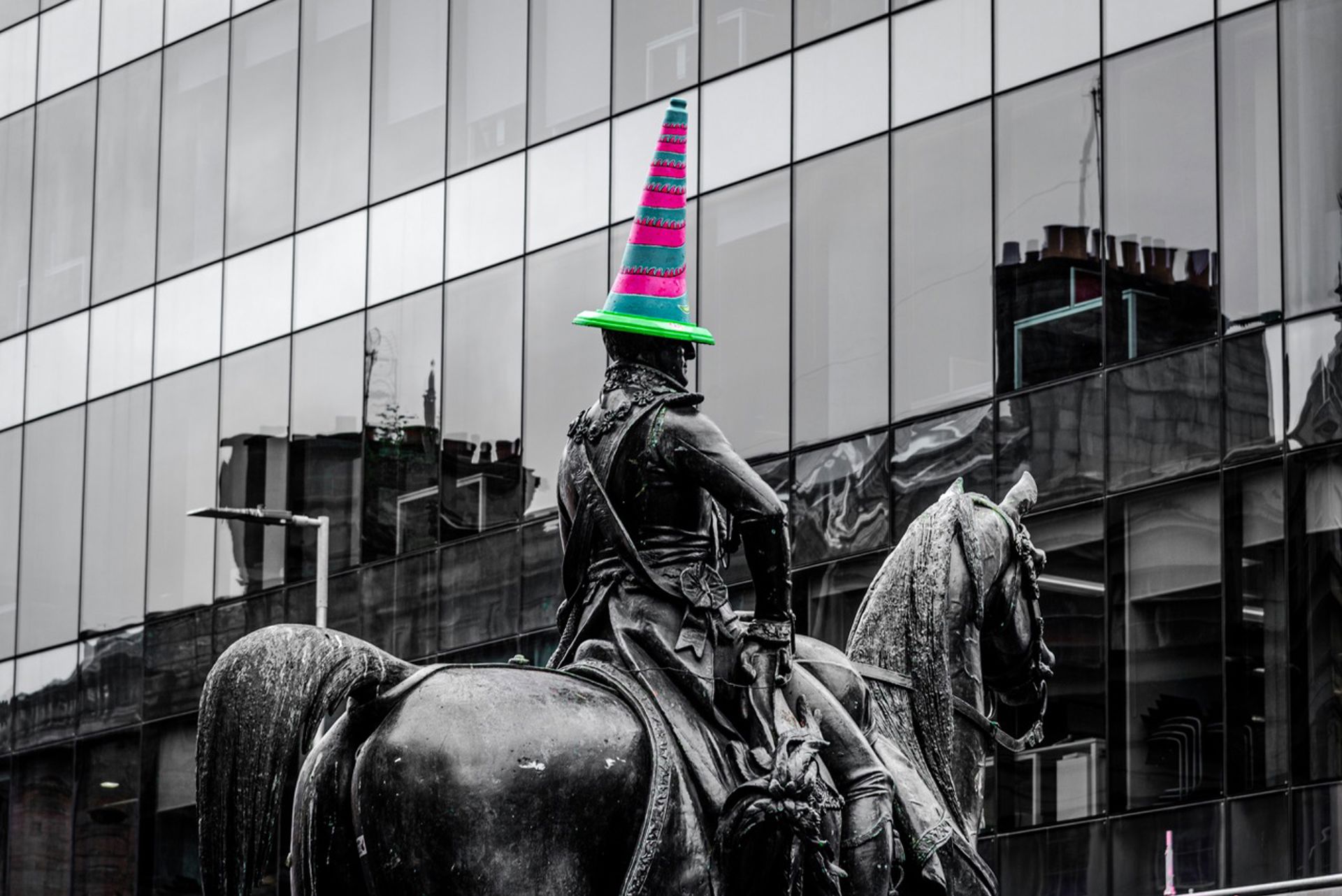
That same grassroots creativity also shaped the visual landscape of their visit. In Boston and Providence, it became common to see borrowed traffic cones, balanced on top of statues, echoing a long-standing tradition from Glasgow. There, the Duke of Wellington statue outside the Gallery of Modern Art has, for decades, been crowned with a traffic cone by locals. What began as a spontaneous act of mischief evolved into one of the city’s most recognisable and photographed landmarks, and despite repeated official attempts to remove it, the battle was won by locals.
What connects Glasgow to Boston is not the traffic cone itself, but a playful reclamation of public space. In Glasgow, the traffic cone has become an unplanned yet globally recognised tourist attraction in itself, created, maintained and defended by residents rather than institutions. In the United States, the Tartan Army reproduced this behaviour instinctively, carrying their cultural sense of humour with them and imprinting it onto new environments. In doing so, they demonstrated how tourism experiences can be shaped not just by where people go, but by what they bring with them.
Chartitable Footprint
That same ethos was visible in their charitable footprint. It’s a long-standing tradition among Scotland’s supporters to leave a positive mark wherever they travel, and in 2026 this was clearly evident in New England. Collectively, fans donated tens of thousands of dollars to local causes, including a widely reported $10,000 contribution to the cancer unit at Hasbro Children’s Hospital in Providence, alongside a football education charity and many other local causes.
Alongside this, individual initiatives reinforced that same spirit. Craig Ferguson undertook a transatlantic fundraising journey across the United States in support of Scottish Action on Mental Health (SAMH), linking the World Cup experience to wider social causes both within the USA and back home.
People Power
Taken together, these actions show that tourism doesn’t need to be a passive act of consumption. Unlike top-down tourism strategies, where destinations attempt to control how they are experienced, the Tartan Army represented an organic force, where the fans themselves co-created the experience, not just for themselves, but for everyone around them. Their presence invited participation, and locals didn’t simply observe, they joined in, strengthening a sense of shared connection.
In return, Scotland was promoted on a global stage, not through carefully curated campaigns or official messaging. Instead, it is was marketed and shared in real time by ordinary people, with the fans acting as informal cultural ambassadors, embodying a vision of Scottish identity that is open, warm and welcoming.
More importantly, the host communities developed emotional connections with the visitors, and what emerged was not just tourism, but an unscripted, participatory and mutually enriching exchange.
Of course, this phenomenon exists within the framework of a highly commercialised global event, where much of the infrastructure and revenue is tightly controlled, but even within those constraints, the Tartan Army demonstrated that communities can still exercise agency. They can shape experiences, influence where money flows, and redefine what it means to visit a place.
In this sense, they offered up a powerful model of tourism that is not planned but emergent, not imposed but shared, and long after the final whistle, what people remember is not just the football, but the feeling of being part of something spontaneous, communal and alive.
That is the real power of community-led tourism.
Kenny Lieske, is a Scottish migrant living in England. He works for Good Organisation (Social Venture) CIC, a community-led tourism organisation in York.
Photograph by Carl Jorgensen
Do you want to be a SCOTO Networker, Supporter or Enterprise?
Find out more about how you can join SCOTO